How North Carolina, Maryland and Virginia are building lasting support for wildlife crossings.
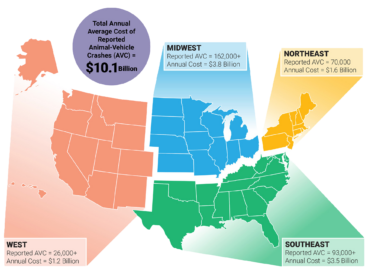
States in the Southeast have one of the most expensive wildlife-vehicle collision (WVC) problems in the nation. These accidents rack up an estimated $3.5 billion dollars in annual damages, in addition to the toll of injuries and deaths for both drivers and wildlife.
 Patricia Cramer
They are also financially sound infrastructure investments. The cost of deer collisions is about $41,000, while an elk collision is about $80,000. By reducing these collisions, we can reduce the associated cost burden on taxpayers. In the case of underpass crossings along streams and rivers, widened crossing structures can also accommodate increased floodwaters, making our roads more resilient to extreme weather events.
As more states recognize the economic, ecological, and public safety value of wildlife crossings, the conversation is shifting from whether they work to how to pay to get them built. As a result, many Eastern Wildway states are finding ways to invest in wildlife crossings.
 Wildlands Network
 A bobcat crosses safely beneath a road through a wildlife underpass in Gorges State Park, in North Carolina's Blue Ridge Mountains.
How The Southeast is Funding Wildlife Crossings
Building a network of effective wildlife crossings takes long-term funding, and there isn’t a one-size-fits-all way to make that happen. Southeastern states are finding their own solutions, and Wildlands Network has been working hard with its partners within these states to help find a meaningful funding fit.
This year, North Carolina made a historic investment for wildlife connectivity and public safety by appropriating a recurring $10.2 million every two years to support wildlife crossing infrastructure across the state. By creating this reliable, dedicated funding source, North Carolina is giving agencies the ability to plan strategically and build and maintain crossings over the long term.
Further north, Maryland demonstrated that the public is willing to support wildlife crossings when given the opportunity. Since launching its Wildlife Crossing Fund last spring, 9,300 residents have voluntarily contributed more than $129,000 when registering their vehicles. These donations send a clear message: people value wildlife crossings and are willing to help pay for them.
After seeing the strong public support for wildlife crossings in Maryland, Virginia created a Wildlife Corridor Grant Fund to support projects identified in its Wildlife Corridor Action Plan. Virginians are now able to donate to the fund directly, or when completing DMV transactions or state income tax returns. These contributions support projects that protect and reconnect wildlife corridors and construct wildlife crossings. They can also help Virginia unlock additional federal funding for these projects.
 Andrew Johnson
 Members of the public, legislators, and members of the media gathered at the Fort Belvoir wildlife crossing in Virginia to learn how it benefits land and aquatic species, reduces flooding, and makes roads safer.
Notably, all three of these committed states have been able to unlock federal funding for wildlife crossing work in recent years.
- In 2023, Virginia won roughly $600,000 from the federal Wildlife Crossings Pilot Program to advance implementation of its Wildlife Corridor Action Plan and identify priority wildlife crossing locations that can improve driver safety and wildlife connectivity.
- In 2024, both Maryland and North Carolina won grants from the same Program. Maryland won $387,000 to create a state plan designed to reduce WVCs by mapping collisions hotspots, improving data collection, and educating the public about habitat connectivity.
- The same year, North Carolina won a historic $25 million from the Program to pay for a set of wildlife crossing underpasses on U.S. 64 and help provide safe passage for Red Wolves, black bear, deer, alligators and other wildlife in the Alligator River National Wildlife Refuge.
Wildlands Network and its partners championed a bipartisan effort to establish the federal Wildlife Crossings Pilot Program in 2021. Since its creation, the program has seen significant demand, with funding requests across its first two application rounds totaling nearly five times the amount awarded.
While Congress has yet to reauthorize the program for another five years, it has signaled support for increasing program funding and making it a permanent Federal Highway Administration grant program within the next federal transportation bill.
Building the Future of the Eastern Wildway
With Congress and the states both signaling their commitments to wildlife crossing infrastructure, we are hopeful we will have a more connected, resilient, and wild Eastern Wildway – with safer roads for both wildlife and people.
Reliable funding is the difference between wildlife crossings being a proven concept, and getting built on the ground. The approaches taken by North Carolina, Maryland, and Virginia offer valuable examples for other states looking to reduce WVCs, reconnect habitat, and build transportation systems that work better for both people and wildlife.
Wildlands Network is planning to share these models and offer additional new funding ideas to other states in the Eastern Wildway, and across the U.S., to ensure that habitat connectivity, public safety, and infrastructure resiliency are key considerations supported by meaningful resources throughout the transportation planning process.

Protect Wildlife on the Move
Every year, thousands of animals are killed trying to cross roads. Your donation helps fund safe crossings throughout the Eastern Wildway.
Donate Today
Misty Boos | U.S. Conservation Policy Manager, Wildlands Network
Related Posts
 Forktailed Media
  Wildlands Network
  Ron Sutherland