Washington, DC, May 21, 2026
Leaders in the U.S. House of Representatives sent a clear signal: wildlife crossings are worth investing in for another five years.
Leaders in the U.S. House of Representatives sent a clear signal: wildlife crossings are worth investing in for another five years. The Transportation and Infrastructure Committee has included the Wildlife Crossings Program within its introduced BUILD America 250 Act, increasing available funding for the next five years, removing “Pilot” from the Program name, and waiving the matching requirements that had previously put this critical program out of reach for many Tribes.
What Today’s Vote Means
This decision to include the program delivers three specific wins that Wildlands Network has been working hard to secure:
- Five more years of increased funding;
- Graduating the program from “Pilot” status; and
- Removing hurdles keeping Tribes from applying.
Increased funding. Program demand has outpaced supply since day one, and construction costs have continued to rise. More funding means more projects, more crossings, and more wildlife able to safely navigate the landscapes we share.
Full federal cost-share for Tribes. This one is especially meaningful. The previous matching requirements effectively excluded a significant number of Tribal nations from accessing a program that can protect culturally important species on their lands. We are grateful the House recognized this hurdle and acted.
A Federal Investment Worth Renewing
Since its creation in 2021, the Wildlife Crossings Pilot Program has directed $350 million in federal funding toward one of the most persistent and solvable problems in conservation: the deadly collision between our transportation infrastructure and the natural world. The program funds everything from the design and construction of wildlife overpasses and underpasses to research and hotspot analysis that identify where crossings are needed most.
The scale of the problem is staggering. “The Federal Highway Administration estimates that, each year, roughly 365 million animals are killed on our roads. That’s more than the entire U.S. population of humans in just one year,” said Erin Sito, U.S. Policy Director at Wildlands Network. “Roads are clearly a significant driver of biodiversity loss.”
Wildlife crossings, paired with directional fencing, can reduce collisions at a given site by more than 90%. They restore what roads sever: the freedom for wildlife to move, find mates, access food and water, and maintain the genetic diversity that healthy populations require. And the projects this program has funded are already making a difference. “Wildlife crossings are a win-win solution, solving for habitat fragmentation and dangerous and costly wildlife-vehicle collisions,” Sito said. “This first-of-its-kind bipartisan program has been very popular and has helped fund some incredible projects to date, including a crossing project that will help the critically endangered red wolf and other large mammals in coastal North Carolina.”
The case for wildlife crossings extends well beyond conservation. Wildlife-vehicle collisions cost Americans an estimated $10 billion annually in vehicle damage alone — and the human toll is real. “In a time when affordability is a concern for many Americans, a collision with wildlife can mean a totaled car, a lost means of transportation to work, and even injuries that lead to missed work and missed paychecks,” Sito said. “We are thrilled that Congress sees the value in this program from both a wildlife connectivity standpoint and a public safety and affordability standpoint.”
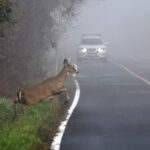
The demand for the program has been overwhelming from the start. “This program has been woefully oversubscribed, with requests from each application period totaling roughly $200 million more than what has been made available for the entire five-year program,” Sito said. “While we are very excited that this key House committee has decided to reauthorize and increase funding for this program, we hope that the Congress will consider increasing the funding further, to keep up with demand and inflation.”
Years of Work on the Hill
Wildlands Network was one of the key advocates and architects of the Wildlife Crossings Pilot Program when it was first created as part of the Bipartisan Infrastructure Law in 2021. Since then, our team has been on Capitol Hill — connecting constituents working on connectivity with their Congressmembers, co-hosting briefings, coordinating fly-ins, and making the case, year after year, for why this program deserves not just renewal but expansion.
The BUILD America 250 Act was introduced in the weeks following our Earth Day advocacy on the Hill and a congressional briefing we co-sponsored to highlight the program’s impact and the enormous unmet need. Those conversations matter. They’re how policy gets made and advances.
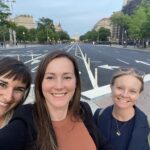
Erin Sito, Mari Galloway, and Nikki Robinson represent Wildlands Network on Capitol Hill, urging lawmakers to renew the WCPP.
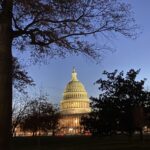
U.S. Capitol Building, Washington, D.C. Photo by Erin Sito
We are deeply grateful to Committee Chair Graves and Ranking Member Larsen for their bipartisan leadership on this issue. Their willingness to champion wildlife crossings as a public safety and conservation priority is both meaningful and necessary.
We also want to recognize our partners and organizations who have been working tirelessly alongside us to coordinate on this effort for years: ARC Solutions, National Parks Conservation Association, The Pew Charitable Trusts, The National Wildlife Federation, The Native American Fish and Wildlife Society, The Theodore Roosevelt Conservation Partnership, The Nature Conservancy, Environment America, and the Center for Large Landscape Conservation. This kind of long-term, coalition-based advocacy is how change actually happens.
The Road Ahead
There is still ground to cover before this bill becomes law. The bill must move from Committee to the House Floor for a vote. Then the Bill would head to the Senate, where we urge Senators to increase the program’s funding to better reflect current demand and construction costs.
We hope you’ll join us. Contact your Senators and let them know that wildlife crossings are a priority: for wildlife, for drivers, for Tribal communities, and for the long-term health of the landscapes we all depend on.
Sign up for our newsletter to follow this bill’s progress in the House and Senate — and to stay informed on the federal policy work that moves conservation forward.
Join Our Wildlife Crossings Campaign
Explore now Pathways for Wildlife
Wildlands Network
Related Posts
 Forktailed Media
  Andrew Johnson
  Ron Sutherland