As wildfires intensify, community-led brigades fight to save the last stronghold of the thick-billed parrot.
Once, thick-billed parrots threaded the skies between the old-growth pine forests of northern Mexico and the American Southwest — brilliant, noisy travelers whose droppings seeded new forests in their wake. Today, surveys suggest fewer than 2,500 remain, none of them north of the border, their numbers hollowed out by decades of deforestation, agricultural expansion, logging, and capture for the pet trade, with increasingly fierce wildfires now threatening what little nesting habitat remains in the Sierra Madre Occidental.
For more than 26 years, Wildlands Network has worked alongside communities of the state of Chihuahua, in places like Tutuaca and Conoachi to hold the line — purchasing logging rights to retire them, helping win federal protections, and equipping local fire brigades to defend the forest — and over the next five years, that work deepens: mapping old-growth stands, training communities to monitor parrot populations, and building the kind of integrated, community-led stewardship that can one day follow the parrots across their full range, from summer breeding grounds in Chihuahua and Sonora to their winter forests in Durango and Sinaloa, restoring not just a bird, but the living corridor it carries with it.
Today, in the middle of summer, the community breathes a sigh of relief. The 2026 fire season has ended, and thanks to heavy rains, the impact was less severe this year. Always on alert for possible off-season fires, brigade members stack wood in rows designed both to reduce the area affected by any future fires, and to retain the thin layer of soil that gives life to these forests. Meanwhile, community monitoring brigades are getting ready to welcome the chicks, expected to hatch in the coming weeks, when active nests will be counted to assess the status of this small parrot population fighting extinction.
A changing fire landscape
Laura Barragán participated in the working group that crafted the conservation management plan for thick-billed parrots. Over the previous 20 years, she has dedicated her career to building capacity within local communities to conserve biodiversity.
This expertise made her a great fit for our own vision and we have now contracted Laura to lead our community-engagement efforts aimed at protecting thick-billed parrots in the Tutuaca and Conoachi areas.
“With my experience, I knew Wildlands Network needed a link between conservation and the people in the community,” Laura observed.
She has witnessed significant shifts in the local climate and fire dynamics in the region over the years. Around 2005, Laura recalls overhearing a conversation among residents that logging activity had to be suspended for five months in the area due to heavy snowfall. In contrast, 2025 only saw two snowfall events.
Snowfalls are not the only natural disturbances to have suffered important changes. A 2005 study examined local trees’ fire scars to analyze the region’s fire history between 1702-1995. It found that fire occurred in the region every 3.9 to 5.2 years, indicating a cadence of frequent, low-severity fires.
“I believe that fire is a natural phenomenon that is an integral part of ecosystems, and that species — particularly humans — have adapted evolutionarily to its presence and to the way we have managed it,” Laura noted. “Whether to use it or not, or how to use it, remains a fundamental aspect of rural life in Mexico.” In agriculture, communities have long used fire as a tool to clear land and control pests and invasive plants.
The advent of modern fire suppression policies altered regional fire patterns. Then came climate change, which is contributing to fires that burn more frequently, more extensively and with increased intensity. Local communities are more vulnerable to extremes in climate, and are having to adapt forestry, agriculture, and ranching practices.


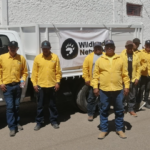
In 2024, a major fire broke out on the western side of the Tutuaca Natural Protected Area. Local terrain facilitated the spread of the fire on a steep slope, complicating the fire brigade’s efforts and triggering the implementation of the “Incident Command System”, which is a standardized fire control protocol used to provide responders with pre-established guidelines that ease cooperation and increase efficient coordination.
The 28-day fire put the crew’s skills and resolve to the test. Ultimately, it demonstrated the success of the ongoing training efforts, and improved access to equipment that Wildlands Network supports. Without prior training in the Incident Command System, responders can be less effective and more at risk, especially when large fires require multiple teams, that have not trained together before, to collaborate.

Sense of pride
Battling a wildfire can be a stressful experience, even for experienced firefighters. Several factors contribute to crews’ success.
Regionally, paid work opportunities are limited. Participating in temporary employment, like fire protection brigades or monitoring teams, can provide needed supplementary income while fostering engagement in local restoration and conservation management projects.
Laura believes that the demanding, arduous nature of forest fire protection work cultivates a deep sense of commitment and belonging amongst firefighters in the reserve area, and on a global scale. The firefighters refer to themselves as the Brotherhood of Prometheus, a nod to the Titan in Greek mythology said to have given fire to humanity.
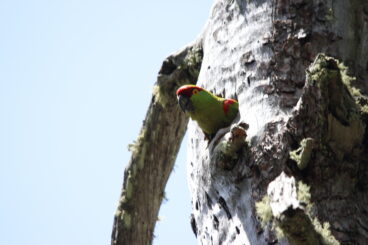 Manuel Escárcega / CONANP
Knowing that the work is in service of the conservation of the thick-billed parrot only strengthens that sense of purpose.
“They are known for their strong sense of solidarity and camaraderie,” Laura shared. “If we add to this the renewed appreciation for the thick- billed parrot in particular, it seems to me that a sense of pride in what their work represents is developing.”

Ongoing training
Earlier this spring, two new monitoring brigade cohorts and two existing ones participated in a workshop to learn about monitoring parrot nests, water sources, feeding areas, and the characteristics of the local ecosystem. Funding for two of the brigades came from CONANP, Mexico’s commission overseeing Natural Protected Areas (NPAs), while Wildlands Network and its partners funded the other two. One new partner this year providing funding for the monitoring is the Cincinnati Zoo.
Carlos Castillo, WN’s Northwest Mexico program director, shares that nformation gathered by the monitoring brigades will be used to update the conservation and management plan for thick-billed parrots, a process he’s advocating to start in 2027.
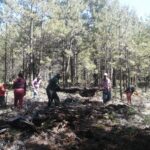
Fire brigade members also received some formal training to professionalize and expand their practices. This year, two brigades received three different trainings.
In one of these trainings, an expert in fire behavior taught the group about how to organize roles within the brigade based on the size of the fire. Another training brought together 30 fire brigades in the area to train on providing a more coordinated and effective response when a large fire breaks out.
The trainings address the interests local firefighters already have, to gain the knowledge necessary to take on more complex fires as safely and efficiently as possible.
“I saw people this year at the trainings with a lot of interest and enthusiasm for trying to be much better organized during firefighting season,” Laura shared.

Looking ahead
This year brought a relatively calm fire season, but the potential return of drought later in the year could yield conditions ripe for an intense fire.
In addition to recent training, fire crews have made firebreaks using a risk map to locate areas where they could be most needed and have the largest impact in preventing a fire’s spread.
Going forward, the crews are in need of some new tires for the brigade’s only truck, and are in the process of locating some additional equipment for a water pump.
On the monitoring side, having birdsong recorders could provide even more data about the parrots by helping the monitoring brigades inventory nesting populations each year.
We hope to continue working with local communities to develop a strategy that supports forest health over time — one that preserves existing nesting sites and increases the nesting population for this special bird.
Laura voices her hope that with our increased engagement and community focus, thick-billed parrots will have a better chance than ever of braving the fiery tides of change and flying out the other side as resilient as ever.
 Manuel Escárcega / CONANP
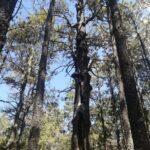

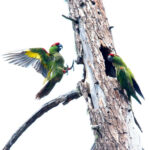 Photo by: Manuel Escárcega / CONANP
 Stay Wildly Connected
Join a movement that’s rebuilding the wild foundations of our continent. Your involvement fuels science, advocacy, and real change on the ground.
Join Us
Wildlands Network
Related Posts
 Mark Dumont