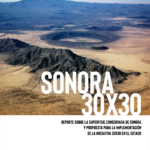
The first “Real Right of Conservation” contract takes effect in southern Sonora, advancing voluntary conservation and long-term ecological connectivity in a region critical to North American wildlife movement.
—
HERMOSILLO, Sonora, Mexico — June 17, 2026
In a historic signing ceremony held yesterday at the Centro Ecológico de Sonora in Hermosillo, conservation partners across Mexico formalized the first contract under Sonora’s newly established Real Right of Conservation (Derecho Real de Conservación, or DRC) framework — a legal instrument that enables landowners to make long-term, voluntary commitments to protect the natural ecosystems on their land.
The agreement was signed by representatives of the Government of Sonora through the Sonora State Commission for Ecology and Sustainable Development (CEDES), alongside Wildlands Network, the French Development Agency (AFD), Bioconnect, CEDO (Intercultural Center for Desert and Ocean Studies), Parque La Colorada, and Naturaleza y Cultura Sierra Madre. Members of the Sonora State Congress’s Environment, Energy and Climate Change Commission, municipal presidents, and university leaders from the state’s two major universities also attended the ceremony.
 CEDES / Ricardo García
Wildlands Network played a central role in making this moment possible, leading the four-year effort to build the technical case for the DRC mechanism and to build relationships with key state lawmakers, government institutions, and landowners in Sonora.
“The most relevant context to understand conservation in Mexico is land tenure,” said Carlos Castillo, Wildlands Network’s Mexico Program Director. “A staggering 95% of land in our country is either privately or communally owned, with no large tracts of public land that can be effectively protected by unilateral government designation. In practice, federal protected areas are a layer of regulation over a mosaic of land tenures.”
That reality makes voluntary conservation mechanisms essential — and the Real Right of Conservation uniquely powerful.
Through actions such as this, the Government of Sonora reaffirms its commitment to protecting natural resources and building a model of sustainable development that ensures the conservation of ecosystems for future generations.
A New Legal Tool Modeled on International Conservation Law
Adapted from a legal framework developed in Chile, the Derecho Real de Conservación functions similarly to a conservation easement but with a key distinction: it requires only the commitment of a single willing landowner, who agrees to dedicate their property to conservation for a minimum of 30 years, and a supervising third party to ensure the land meets conservation requirements and maintains a management strategy.
Between 2022 and 2024, the Sonora State Congress approved amendments to the state’s environmental law that explicitly created the DRC as a new legal instrument, tied it to fiscal incentives for voluntary conservation, and established a state environmental fund to support implementation. The signing ceremony yesterday marked the first contract executed under this framework by Parque La Colorada and Naturaleza y Cultura Sierra Madre.
“The voluntary conservation mechanisms are an easier, more efficient, and more flexible way to protect land under Mexico’s highly fragmented land tenure system,” said Castillo. “Strengthening these mechanisms and adding tools like DRC contracts could help us advance faster toward the 30×30 goals.”
Why This Matters for Wildlife and Connectivity
The Álamos region of southern Sonora is part of a broader landscape essential to the movement of large mammals across the Sierra Madre Occidental — jaguars, mountain lions, black bears, and other wide-ranging species that depend on connected habitat to sustain viable populations across international borders. As traditional approaches to establishing protected areas become more difficult politically and logistically, voluntary mechanisms like the DRC offer a critical path forward.
We are confident that as more landowners join these types of voluntary conservation programs, this will play a significant role in promoting connectivity, particularly for large mammal species that require larger areas of habitat for their local or regional migrations, says Castillo.
By creating durable, long-term conservation commitments on private and communal lands, DRC contracts can help stitch together the fragmented mosaic of land ownership into functional wildlife corridors — a cornerstone of Wildlands Network’s mission across the continent and strategy to reconnect and restore a jaguar corridor in northern Mexico.
Building Momentum: Expansion to Other States
The Sonora signing is already spurring replication. Wildlands Network is actively working with its strategic partner, Terra Peninsular, in Baja California, where a recent meeting with the state’s Undersecretary of Environmental Protection renewed interest in adopting a similar framework. The organization is also exploring the model’s potential in Jalisco and Chihuahua.
“Since the advances achieved in Sonora’s legislation, an ally in Baja California brought this to the attention of the state environmental authorities there — and they asked us to share what we’d learned and how they could implement it,” Castillo noted.
About the Real Right of Conservation
The Derecho Real de Conservación is a voluntary legal mechanism that allows a landowner to establish a binding, long-term commitment to conserve the natural resources and ecosystems on their property. Unlike protected area designations, which require government action, DRC contracts are initiated by landowners themselves — making them a flexible, incentive-backed, and scalable tool for expanding conservation across Mexico’s predominantly privately held landscape.
About Wildlands Network
Wildlands Network is a nonprofit conservation organization working to protect and restore wildlife habitat across North America by creating and connecting wildlife corridors. For 35 years, the organization has championed science-based approaches to landscape conservation from Mexico to Canada.

Wildlands Network
Related Posts
 CEDES / Ricardo García